- Adjustable Rolling Pin
Take all the guesswork out of baking with a rolling pin that ensures the dough is rolled to an even thickness throughout. - Bacon Grill Press
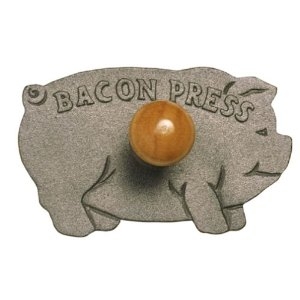
For the obsessive-compulsive carnivore in your life, give them the gift of no more curly bacon. This cast iron press will allow the bacon to keep its shape for even cooking in the pan, and can be used to flatten burgers and sandwiches as well.
Got an obsessive-compulsive vegetarian to buy for? The Obsessive Chef Cutting Boardis just the thing for them. Made from naturally antibacterial beechwood, this cutting board breaks down measurements into perfect squares and angles, even units as small as a julienne.
- Cheat Sheet Kitchen Apron
Know of any cooks who are constantly running to their smartphone every time they need to convert a weight or measurement when cooking? This stylish apron will help them out and keep them clean all at the same time. - iPad Cutting Board
Of course some people can't bear to be away from their tablets. Made with four rubberized anti-slip feet, and a juice groove to keep the iPad and the counter top dry, this cutting board was designed with those people in mind.
You also may consider the gift of apps to the constantly connected. Two good ones are Mark Bittman’s essential cookbook “How to Cook Everything” and the digital rendition of Modernist Cuisine At Home. These are exclusively for Apple users, Android users like myself would have to rely on the BigOven or the Food Network In the Kitchen apps available at Google Play. - DSV Sous Vide Controller
With this device, you can turn a slow cooker into a sous-vide machine with ease - how you vacuum-seal your food though, is up to you. - Infrared IR Non-Contact Digital Thermometer
Instantly check the surface temperature of food or anything else in the house in seconds with an accuracy of +/- 2.5%. It won't replace the probe thermometer for internal temperatures but it's still a cool device.
But if you know of someone who needs a cool probe thermometer, consider giving them the Thermapen. Accurate to within less than a degree (±0.7°F , or ±0.4°C), this is a favourite of noted kitchen-gadget authority Alton Brown. - Mobile Foodie Survival Kit
A foodie will never have to rough it on a camping trip ever again with this mobile spice rack. This kit starts them out with a good variety of herbs and spices, and the containers are reusable so people can add their own favourites. - Molecular Cocktails Starter Kit
This is the perfect gift for anyone who hosts viewing parties for "Top Chef". Pair it with one of the Modernist Cuisine Cooking Kits to create the ultimate foodie dinner party. - One Stop Chop Cutting Board
With its raised bamboo surface, this cutting board has three storage drawers underneath, making prep work that much easier. - Sauced Measuring Wine Glass
For the oenophile on your list, what could be better than a lead-free-crystal all-purpose wine glass, marked in 1/4 cups and 2-ounce sips? If you said "wine", include a gift card from the LCBO.
Thursday, November 28, 2013
Foodie gift list - 2013


Monday, November 25, 2013
Science and Cooking: From Haute Cuisine to Soft Matter Science - Week 4
As I posted in my October 13th blog entry, I've enrolled in an on-line course about the relationship between science and cooking. It's been awhile since my last post about this course, for reasons that may or may not have to do with "Batman: Arkham Origins", and a neglected stack of laundry.
Here's what went down on the fourth week.
- This week the topic is elasticity, and one of the guest lecturers is White House Pastry Chef Bill Yosses.
- Who knew the White House had its own pastry chef? I wonder if either Barrack or Michelle has ever asked him to whip up a batch of cro-nuts for them.
- To measure elasticity, we are shown how it is measured with a spring. This principle of physics, called Hooke's law, states that the force needed to extend or compress a spring by some distance is proportional to that distance. That is, F = k x, where k is a constant factor characteristic of the spring, its stiffness.
- What does this have to do with food? Elasticity in food relates to how it feels in your mouth when you chew it. For example, the elasticity of a steak will increase as it becomes more difficult to chew the longer it is cooked.
- I had no idea there were different mouth feels for tofu, or that firm and soft tofu even existed.
- The mathematical description of an object or substance's tendency to be deformed elastically (i.e., non-permanently) when a force is applied to it is E = U over I3, where U is the interaction energy between the bonds in the material, and I is the distance between them. This is also the equation of the week in case you were wondering.
- We are treated to a scientific look at the making of strudel, which leads to a discussion about gluten, the protein that gives strudel dough its special characteristics.
- Did you know hearing plays a part in the enjoyment of food? Harold McGee talks about an experiment done at Oxford University where the subjects put on sound-blocking headphones, and sat in front of a microphone, and bit into potato chips. The sound of the biting was picked up by the microphone and processed before the sound was passed back to the eaters' ears through the headphones. When the chewing sound was sent to the headphones unchanged, the eaters rated the chip as normally crisp. When the sound was amplified, they rated the chip as more crisp.
- McGee also mentions anthropologist Richard Wrangham's belief that because cooked food is often easier to chew, the invention of cooking has had a profound effect on the evolution of the human species.
- Dan Souza from America's Test Kitchen and Nathan Myhrvold of Modernist Cuisine fame both recommend slow-roasting tough cuts of meat, like an eye of round roast - who am I to argue?
- Poking your meat full of holes can make it be more juicy. This process is called jaccarding, and is done with a device not surprisingly called a Jaccard. A Jaccard has tiny blades that cuts little bits of the muscle fibers weakening the collagen fibres in them without cutting the meat totally. By poking the meat with holes, the collagen fibers do a less effective job squeezing the moisture out of the meat when it's being cooked.
- Note to self: Invest in a sous-vide machine so I can experience a short rib slow cooked for 72 hours.
- We end Week 4 with a summary of elasticity and another appearance by Bill Yosses, who demonstrates how, with a little sugar, water, and glucose, you can make a candy apple.
Saturday, November 9, 2013
Science and Cooking: From Haute Cuisine to Soft Matter Science - Week 3
As I posted in my October 13th blog entry, I've enrolled in an on-line course about the relationship between science and cooking. A very video heavy week this time out - food porn fans would really appreciate all the detail that went into the making of this course.
Here's what went down on the third week.
- The guest presenters this time out are Joan Roca, who runs the world-famous restaurant El Celler de Can Roca in Girona, Spain with his two brothers; and Dan Souza, senior editor for Cook's Illustrated Magazine, and current cast member of the America's Test Kitchen television show, radio program and podcast.
- This week we learned about the various phase transitions foods can go through in the cooking process. While a change in temperature can cause a phase transition, a change in pressure can also make this happen.
- A pressure cooker works by trapping some steam as water inside it boils, thus increasing the pressure and raising the boiling point. When the boiling water reaches this higher boiling point, it transfers heat to the food more quickly than water at just 100 degrees Celsius. This is a much better way to explain how a pressure cooker works than the method used to describe what happened in Boston back in April of this year.
- Want to cook the perfect egg, one with a temperature of about 64 degrees Celsius, perfectly every time? As water boils at a lower temperature as you gain altitude, just climb a tall enough mountain. Unfortunately, the boiling point of water on the top of Mount Everest is about 71 degrees Celsius, so you're going to need a bigger mountain.
- Chef Roca then demonstrates some of his renowned sous-vide cooking techniques by cooking, among other things, eggs and a fillet of sole.
- Another method to cause a phase transition is to use a rotovap, which is used in laboratories for the removal of solvents from samples by evaporation, and in cooking for the preparation of distillates and extracts. Check eBay for one if you ever need to distill the essence of something in one of your dishes.
- The concept of entropy has been introduced; I don't recall ever hearing about entropy in either elementary or high school science class, but I'm learning about it as part of a course about cooking, go figure.
- To be fair, I don't recall getting as much background in the half semesters of elementary school home-ec class either. Maybe it's time it should...
- Still haven't clapped for the equation of the week. This time it's U = CkBT.
- A chemical breakdown of fats and a discussion about the science of supercooling follows, along with an explanation of why you can't make water as salty as you can sweet. Thanks to this course, I now know that the solubility of any compound, is similar to the phase transition between a solid and a gas.
- I scream, you scream, this week's lab involves the making of ice cream - sweet.
Thursday, November 7, 2013
Cooking the Google Way
Much to the dismay of Microsoft, Google is the most used search engine is the world. It's incredible how much this company has affected our lives since its inception in 1997, and one of the latest features from the boys out in Mountain View, California is Google Helpouts, a new service that connects you to experts, live over video chat, to get help with issues ranging from home repair, learning a new language, or general lifestyle advice. Many of them are completely free, so here are some suggestions that many be of interest to the wired foodie.
- Basic Cooking
Need help cooking? Rouxbe chefs are here to help with your questions about basic cooking, recipe troubleshooting or to simply help you get dinner on the table. - Improve your Food Photography
Be the darling of Instagram with these tips from Earl Lee, a food blogger with over 5 years of food photography experience. - Kitchen Catastrophes Solved
Is your soufflé sad? Your stew lacking spice? Your steak kinda grey? Run out of menu ideas for a dinner party? Let Sherród Faulks, the creator of Sunday Supper Club video series help. - Learn about Coffee: Advice from Roasting to Tasting
Baristas aren't the only people who know from coffee, become more of a coffee connoisseur with the advice for this small batch hand roasting expert. - Top Chef University
Want to cook like your favourite Top Chef? Got some money you want to spend? If you answered "yes" to both of these questions, you now have access to over 50 hours of video cooking content, 220 video lessons and footage from 11 of the most popular contestants from the Emmy Award winning show. - Urban farming basics: how to grow your own vegetable garden
In this Helpout, you'll get information about garden size, what to grow, where to grow it, how to take care of your plants, as well as tips on the herbs and vegetables you should pick for your climate and personal preferences, and how to make it work with available space for planting.
Tuesday, October 29, 2013
Eggplant with Buttermilk Sauce - Science and Cooking: From Haute Cuisine to Soft Matter Science
As I posted in my October 13th blog entry, I've enrolled in an on-line course about the relationship between science and cooking. Part of the week one homework was to follow a recipe and answer some questions about the dish that was made. Buying one of the ingredients in this dish lead me to the Mid-East Food Center, which I will be visiting again when it's time to restock the pantry. Neither Dawn or myself are big fans of eggplant, but we both loved the sauce that goes with this dish, and I would try this dish again, only this time I'd try grilling the eggplant. That being said, until I find something tastier to replace it, this will be my go to dish for any vegetarians I encounter in my cooking journey.
Ingredients

2 eggplants, cut in half lengthwise and scored
120 mL + 20 mL olive oil
7.5 mL thyme
1 pomegranate
5 mL/3 g za'atar (Google for substitutions, if necessary)
133 mL buttermilk (or 133 mL milk + 7.5 mL distilled/white vinegar)
1 crushed garlic clove
salt and black pepper for seasoning
- Preheat an oven to 200°C.
- Place eggplant halves flat side-up on a baking sheet and brush with 30 mL olive oil apiece. Season with thyme, salt, and pepper.
- Roast for 40 minutes, remove from oven, and allow to cool to room temperature.
- If buttermilk is not available, add vinegar to milk, stir, and let sit for 5-10 minutes to develop into acidified buttermilk. Mix in yogurt, remaining olive oil, garlic, and salt to season. Store in refrigertor while eggplant cools.

- Remove seeds from pomegranate. Serve by spooning sauce over eggplant halves and sprinkling za'atar and pomegranate seeds on top.

Saturday, October 26, 2013
The Beetlejuice and Stay Puft Cocktails
Happy Halloween everybody. These beverage are perfect for that costume party you're going to, or for either after or before you've taken the kids out trick-or-treating. Please remember to drink responsibly.
Tuesday, October 22, 2013
Science and Cooking: From Haute Cuisine to Soft Matter Science - Week 2
As I posted in my October 13th blog entry, I've enrolled in an on-line course about the relationship between science and cooking. Still haven't had the chance to try any of the recipes, still trying to a get a better grasp of the science portion of the lessons. Not enough hours in the week, but no one ever said taking a Harvard on-line course would be easy.
Here's what went down on the second week.
- This week's guest lecturer is Dave Arnold. Week 2's focus is on energy, temperature, and heat, so naturally we begin with a recipe to carbonate a cocktail to show what happens when you mix ethanol and water. I knew I signed up for this class for a reason.
- Because they're scientists, the instructors like to make things quantitative, in the belief that when we start to make ideas quantitative, then we'll start to understand qualitatively better.
- The benefits of sous-vide cooking is then demonstrated in an example using eggs cooked at various temperatures in a very small window between 57 Celsius and 70. Accurately controlling the temperature can make a great deal of difference - something to keep in mind when you're trying to make the perfect Eggs Benedict or eggs on toast.
- Equation of the week: equals mc sub p delta t. (Or heat equals mass x specific heat capacity x change in temperature). You can use that equation to calculate how much energy you have to put into heating a cup of water.
- Start with water that's at room temperature, in this case, about 23 degrees Celsius. One cup of water is 237 grams. We are going to heat it to the boiling point, 100 degrees Celsius. The specific heat (c sub p). for water is 4.18 joules per gram degree Kelvin.
- How much energy do I have to dump in? Using the equation Q is equal to mc sub p delta t, put in that m is equal to 237 grams, that c sub p is equal to 4.18 joules per degree Kelvin, and that delta T is 77 degrees Celsius (100 degrees Celsius - 23 degrees Celsius, the final temperature minus the initial temperature) If we multiply all of these things out, we got 237 times 4.18 times 77. So that's how much energy it takes to boil a cup of water -76 280 joules.
- What does that mean? Think about it like this, how much wood would you have to burn in order to make this much energy? If you take the energy density of wood, 14 megajoules per kilogram, then you can calculate for yourself that the amount of wood that it takes is 76 280 joules divided by 14 megajoules per kilogram, which is 5.4 grams of wood.
- Just for fun!: Go look at the power output of your microwave, calculate how long does it take for you to generate the 76 280 joules needed to boil water. If you put water in a cup in your microwave for that amount of time, does it actually boil? If not, why not?
- NOTE: Most microwaves have a power output of about 400 watts.
The watts to joules calculation is the energy E in joules (J) is equal to the power P in watts (W), times the time period t in seconds (s): E(J) = P(W) × t(s). - I got 190.7 seconds, feel free to let me know if my math is off (scroll over to see).
- You really see how much you don't know about a topic when you answer all the week's pre-questions.
- The liquid nitrogen lecture reminds me of an experiment I've been meaning to try, and of a cool food truck I saw on an episode of Eat St. recently.
- Think of heat as the most used and the most mysterious ingredient in your kitchen --> Harold McGee
- Heat: the total energy that results in the temperature of a system
Temperature: the measure of energy in the motion of molecules in the material - Want a quick way to calculate the number of calories in what you're eating? Use the 449 rule.
- We end with a demonstration of the coffee-infused rum cocktail the cafe Touba being made, and some more fun with equations involving latent heat.
Subscribe to:
Posts (Atom)
Festive Holiday Baking
Are you a hybrid worker being forced to attend an office potluck? Do you need a dessert for your child's Christmas bake sale? Feel l...
-
 With rib festivals happening numerous times throughout the year over the city, Ottawa's love for grilled meat has been well establishe...
 -
 If you lived in Ottawa at any point in the 80s, you saw one of these cartoons on CJOH at noon - the underrated " Rocket Robin Hood ...
 -
 The WORKS Glebe (580 Bank St.) The B.A.B Burger ($15.96) The B.A.B. A common gimmick for food blogs is to eat and review every popula...