Showing posts with label oven. Show all posts

Monday, November 30, 2015

New Oven, First Meal

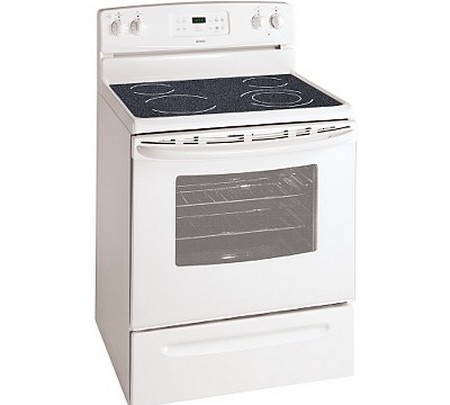
Last Sunday my oven died on me while I was making dinner. After finishing the chicken on the BBQ, and the mac and cheese on the stovetop, I ordered a new range and made arrangements to remove our old cooking workhorse. Our new range is white, has four burners, and isn't anything fancy, but that no reason to not christen it with a new recipe. I decided on Tyler Florence's smothered pork chops, mostly because it popped up on my Facebook feed when I trying to think about what I wanted to make, and because I had all the ingredients for it on hand. While we ate and enjoyed our meal, I made a toast to the oven that I cooked many a meal on and in over the past ten years. I look forward to making many more with its replacement.

Ingredients
4 pork chops, 2-cm thick, bone-in
128 g all-purpose flour
30 g tablespoons onion powder
30 g garlic powder
5 g cayenne pepper
5 g salt
2 g freshly ground black pepper
250 mL chicken broth
125 mL buttermilk
60 mL olive oil
  1. Put the flour in a resealable bad and add all the spices. Pat the pork chops dry with paper towels to remove any moisture and then drop them in the bag of seasoned flour. Seal and shake the bag for a few minutes to cover the chops, then shake off any excess flour from the meat, and set them aside.
  2. Heat a large sauté pan or cast iron skillet over medium heat and coat with the oil. When the oil is nice and hot, lay the pork chops in the pan in a single layer and fry for 3 minutes on each side until golden brown. Once cooked, remove the pork chops from the pan.
  3. Add some of the seasoned flour to the pan drippings. Mix the flour into the fat to dissolve and then pour in the chicken broth in. Let the liquid cook down for 5 minutes to reduce and thicken slightly. Stir in the buttermilk to make a creamy gravy and return the pork chops to the pan, covering them with the sauce. Simmer for 5 minutes until the pork is cooked through. Season with salt and pepper before serving.

Saturday, October 19, 2013

Science and Cooking: From Haute Cuisine to Soft Matter Science - Week 1

As I posted in my October 13th blog entry, I've enrolled in an on-line course about the relationship between science and cooking. Here's what went down on the first week. I'm liking the course so far, I just wish I could manage my time better to get through all the labwork. Just like back at Algonquin - some things never change.
  • The course starts with a welcome and an overview from some of the instructors Michael Brenne, Pia Sorensen, and Dave Weitz, an applied mathematician, a chemist, and a physicist, respectively. They talk about learning about the underlying scientific principles of food and cooking, and about some of the cooking labs we'll get a chance to do in the course.
  • Ferran Adrià introduces himself in the next video, and talk about his background in cooking, and his new project, the El Bulli Foundation.
  • The author of the textbook we're usingHarold McGee  talks for a bit about the place he did most of his research for the book, the Schlesinger Library for the study of women in history at Harvard. I was surprised to learn that people where interested in the science of cooking since the 17th century, and that the pressure cooker has existed since 1681 (thanks Denis Papin).
  • In between the videos are a series of short-answer questions about what we've watch so far. Participation in the online exercises do not contribute to my grade, what counts are the homework assignments, the lab exercises, and the final project. I'm still not sure if I'm going to complete the course for the certificate, or if I'm just learning for the sake of learning yet...
  • Next we see an example of spherification, a form of gelation first pioneered by Adria
  • Lecture 2 get right into the science part of the course with a decision about the molecules that make the food we eat. We are then asked to calculate the number of molecules in a 250mL glass of water. Terms like grams per mole, atomic mass unit, and Avogadro's number are being thrown around. I now see why a knowledge of high school physics and chemistry was considered a useful prerequisite for this course. So if you thought this was going to be a bird course, you're either sadly mistaken, or a lot smarter than I am.
  • I'm introduced to the practice of clapping when the Equation of the Week is introduced during the lectures as a way to get people excited about the science...sure. I'll just say I clapped while I watch the lectures.
  • One of the tasks in the week 1 lab is calibrating your oven using sugar. Sugar melts at 366 F (186˚C). If sugar melts at 350 F (177˚C), your oven is running hot. I preheated my oven at 350 F for 10 minutes and placed in it half a teaspoon of sugar in an aluminum pan.

    Here's the result 15 minutes later.

    Looks like I'm running hot, I may choose to calibrate it better using a oven thermometer.
  • The homework portion finally gets to some cooking, but I didn't get a chance to buy the required groceries. I'll keep you posted my efforts.

Festive Holiday Baking

Are you a hybrid worker being forced to attend an office potluck?  Do you need a dessert for your child's Christmas bake sale?  Feel l...